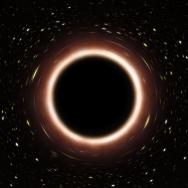
Gigantic black holes lurk at the center of virtually every galaxy, including ours, but we’ve lacked a precise picture of what impact they have on their surroundings.
A University of Chicago-led group of scientists has used data from a recently launched satellite to reveal our clearest look yet into the boiling, seething gas surrounding two supermassive black holes, each located in the center of massive galaxy clusters.
“For the first time, we can directly measure the kinetic energy of the gas stirred by the black hole,” said Annie Heinrich, UChicago graduate student and among the lead authors on one of two papers on the findings, released in Nature. “It’s as though each supermassive black hole sits in the ‘eye of its own storm.’”
The readings came from the satellite XRISM, which was launched in 2023 by the Japanese Aerospace Exploration Agency in partnership with NASA and the European Space Agency. It has a unique ability to track the motions and read the chemical makeup of extremely hot, X-ray emitting gas in galaxy clusters.
“XRISM allows us to unambiguously distinguish gas motions powered by the black hole from those driven by other cosmic processes, which has previously been impossible to do,” said Congyao Zhang, a former UChicago postdoctoral researcher, currently at Masaryk University, who co-led the Nature study.
Messy eaters
Supermassive black holes are fascinating to scientists on many levels, but one important aspect is that they are often “messy eaters.” As stars and gas are pulled towards the black hole’s event horizon, streams of energetic particles are launched near the speed of light. These streams can stir the gas and inject tons of energy into the area surrounding the black hole. This influence extends far beyond the vicinity of the black hole—reaching hundreds of thousands of light-years away.
Scientists have long suspected that these black holes play a big role in shaping galaxies, both within and outside of galaxy clusters, by regulating the rate of star formation. How this process works in detail is still murky, but is key to understanding the evolution of galaxies.
Some evidence of supermassive black holes influencing the gas around them has previously been seen in X-ray images. However, these are only static pictures of a dynamic process. The new XRISM satellite allows astronomers to better understand the black hole’s influence by precisely measuring the energy of X-rays coming from the hot gas.
Each element in the gas emits light of particular energies, like atomic fingerprints, which XRISM detects. The shape of these fingerprints tells scientists how fast the gas is moving.
This adds an entirely new dimension to the picture.
“Before XRISM, it was like we could see a picture of the storm,” said Heinrich. “Now we can measure the speed of the cyclone.”
Turbulent motion
One of the studies looked at the Virgo Cluster, the closest galaxy cluster to Earth and host of the famous supermassive black hole M87*. The proximity of the cluster gives XRISM the ability to ‘zoom in’ on a relatively small region around the black hole. The data revealed the strongest turbulence yet measured in a galaxy cluster—more rapid even than that observed when galaxy clusters merge, which is one of the most violent cosmic events since the Big Bang.
“The velocities are high closest to the black hole, and drop off very quickly further away,” said Hannah McCall, graduate student at UChicago and primary author on the paper analyzing the Virgo Cluster, accepted for publication in The Astrophysical Journal. “The fastest motions are likely due to a combination of eddies of turbulence and a shockwave of outflowing gas, both a product of the black hole.”
The scientists also looked at the Perseus Cluster, the cluster of galaxies that shines most brightly in the X-ray spectrum from Earth. Its luminosity allowed scientists to map the gas motions both immediately around the cluster center and a little further away. They could clearly see a distinct boost in velocities powered by the black hole, on top of the large-scale gas motions that are driven by a different event—Perseus currently merging with a chain of galaxies.
This provides clues into an ongoing scientific question about how supermassive black holes affect the number of stars that form around them.
For years, astronomers have noticed fewer stars than they would expect in the centers of these large galaxy clusters. One potential explanation is the heat from the gas around black holes. According to the new data, if the energy of the gas motions is fully converted into heat, the scientists said, it would be just enough to counteract the rapid gas cooling that fuels star formation.
“It remains an open question whether this is the only heating process at work, but the results make it clear that turbulence is a necessary component of the energy exchange between supermassive black holes and their environments,” said McCall.
As XRISM continues to take data, scientists hope to shed more light on the relationship between black holes and their galaxies, including how the interaction varies with time, how violently the black hole injects energy into its surroundings and how this energy is converted to heat.
“Based on what we’ve already learned, I am positive we are getting closer to solving some of these puzzles,” said Irina Zhuravleva, associate professor of astronomy and astrophysics at UChicago and a co-author of both studies.
Citations:
“Disentangling Multiple Gas Kinematic Drivers in the Perseus Galaxy Cluster.” XRISM Collaboration et al, Nature, Jan. 28, 2026.
“A XRISM/Resolve view of the dynamics in the hot gaseous atmosphere of M87.” XRISM Collaboration et al, accepted to The Astrophysical Journal.
Funding: The bulk of the funding was provided by NASA, Japan Aerospace Exploration Agency, Alfred P. Sloan Foundation, and Czech Science Foundation.