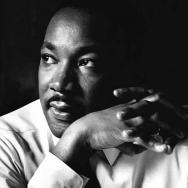
In August 1967, Dr. Martin Luther King Jr. asked: “Where do we go from here?”
That address, delivered to leaders at the Southern Christian Leadership Conference in Atlanta, was among the words recently recited by members of the University of Chicago and local communities during the University of Chicago’s third annual Dr. Martin Luther King Jr. Community Reading event.
More than 40 people from the campus and local communities volunteered to speak at the Jan. 27 event. Among them was UChicago staff member Michael Jennings, who recited that famous speech from Dr. King. Like Jennings, each person brought the civil rights leader’s compelling words to life in new ways.
“I was surprised at the way the reading was making me feel,” said Jennings, an administrative specialist at UChicago Dining, of his experience. “It almost placed me in that moment, just to imagine some of the things I was saying and the impact it was having on the audience at that time.”
Readers approached the podium in the Divinity School’s Swift Hall Common room, which hosted the continuous oration of Dr. King’s speeches, from 9 a.m. to 5 p.m. Participants gathered in groups or came alone to sit and listen to both well-known quotes and to discover unfamiliar words from King’s collection of speeches. The event was hosted by the Martin Marty Center for the Public Understanding of Religion.
Curtis Evans, an associate professor at the Divinity School and the faculty co-director of the Marty Center, was the first to read Dr. King’s words. Other volunteers included members of the Harris School of Public Policy and the Crown Family School of Social Work, the Provost’s Office, UChicago Dining Commons, faculty from Northwestern University, and leaders from Christian parishes in the city.
“From year one to three, we have grown a much larger community representation,” said Emily Crews, executive director of the Marty Center. “Every year has involved people from around the University, and even folks we didn’t know before, but this year we probably have the greatest representation of community members.”
Added Jennings: “The different voices gave you somewhat of an affirmation that things have changed because there is a diverse group reading today,” he said. “But the reading also shared with us that we have a long way to go as a people.”
—Adapted from a story written by Natalie Wilson and first published by the Divinity School.