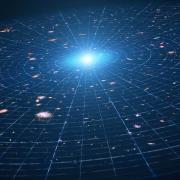
Dark matter is some kind of substance that has gravity—it holds galaxies together—yet cannot be directly seen with any instrument yet created.
We know it’s out there because of the effects it has on things that are visible, like stars and galaxies. We see these effects everywhere we’ve looked, and the consistency makes scientists very certain it exists. In fact, it makes up about 85% of all the matter in the universe.
Scientists, including at the University of Chicago, are trying many different approaches to find the nature of this mysterious substance.
Jump to a section:
- What is dark matter?
- How do we know dark matter exists?
- How much dark matter is there?
- What are the top theories for dark matter?
- Who discovered dark matter?
- How do we find dark matter?
- Why is it so hard to detect?
- What’s the difference between dark matter and dark energy?
- Is dark matter dangerous?
- How are scientists at the University of Chicago looking for dark matter?
What is dark matter?
“Dark matter” is a term scientists use for an unseen substance that is causing strange effects when we look out at the stars.
Out in the universe, we see huge clusters of stars and galaxies. They stick together instead of drifting apart because their mass creates gravity that holds them together—the same reason why we stay on Earth instead of floating away. But when scientists add up the visible mass in these stars and galaxies, there’s not enough to create sufficient gravity to hold everything together. So there is something out there that creates gravity, but doesn’t show up on telescopes.
This unseen stuff consistently appears everywhere we’ve checked. In fact, it makes up about 85% of the matter in the universe. Scientists think it exists as an invisible web extending across the universe, creating a scaffold for all the stars and galaxies that we see around us. Without dark matter, the universe would be smooth and uniform all the way across—and we wouldn’t exist.
In all likelihood, we are standing in a sea of dark matter and don’t know it, because it virtually never interacts with our atoms.
How do we know dark matter exists?
Dark matter is like an invisible poltergeist: Instead of seeing it directly, we humans can only track it by the things it does.
So far, we are only able to “see” dark matter by its effects on objects out in the universe. There are three independent ways we have seen it:
- It was first discovered when scientists noticed there had to be something making extra gravity to hold stars and galaxies together.
- We can also measure dark matter by noticing when it bends visible light. As light from stars or gas travels across the universe, for example, it can be bent by the gravity of things it passes. This creates a characteristic “fishbowl” effect, known as gravitational lensing.
- Finally, we can look at the faint light that is still traveling across the universe from just after the Big Bang, known as the cosmic microwave background. By mapping the tiny fluctuations in this light, we can make out that there was dark matter very early on in the universe.
In all cases, the evidence for dark matter is overwhelming. Everywhere scientists have looked for its hallmarks, it’s there—even in our own galaxy.
“All these completely different sources of evidence point to the same place,” said David Miller, UChicago professor of physics. “So we’re very confident that something is there—but there are many, many forms it could take.”
How much dark matter is there?
Scientists think that dark matter makes up about 85% of all matter in the universe. If you add up all the matter and energy in the universe, dark matter accounts for about 27% of the whole thing.
To find this number, scientists work backward. They look at the galaxies around us and calculate how much more mass would be needed to hold these galaxies together, based on the laws of gravity. That number is about five times more than the visible matter we see. So the universe is about 15% visible matter and 85% dark matter.
What are the top theories for dark matter?
Scientists have come up with many possible explanations for the nature of dark matter. Most of these explanations, if true, would solve other long-standing mysteries in physics besides dark matter.
The top contenders include:
- WIMPs. Dark matter could be made up of particles called WIMPs, for Weakly Interacting Massive Particles (a term co-coined by UChicago Prof. Michael Turner in a 1985 paper).
WIMPs would have about 100 times the mass of protons. This theory is attractive to physicists because it would complete a hypothesis that every particle has a counterpart, known as supersymmetry. In this theory, these particles would only occasionally interact with other particles.
Once the leading explanation for dark matter, the WIMP theory has begun to lose some traction as more and more searches turn up empty.
- Axions. Dark matter could also exist as very light particles known as axions, each on the order of a trillion times lighter than an electron.
Scientists like the idea because it would solve a puzzle in our existing Standard Model of particle physics known as “CP violation.” (The name axion comes from a brand of laundry detergent, because it ‘cleans up’ a problem.) But if axions exist, they would be very difficult to find. They would be so small that they would behave more like a wave than a particle, which changes the type of experiment that would need to be designed to detect them.
- The “dark sector.” Some scientists have posited that dark matter could be made of particles lighter than the proton from a world of matter that exists alongside our own but only interacts tangentially with normal matter—known as the “dark sector” or “hidden sector.” There could be “dark” versions of atoms and photons, for example.
- Primordial black holes. The effects of dark matter could be caused by black holes that have been wandering the universe since just after the Big Bang. Once considered a somewhat unlikely theory, primordial black holes have gained a little more traction in the scientific community as we’ve detected surprising findings about black holes with an instrument called LIGO.
Dark matter could also exist as a combination of one or more of these theories.
Who discovered dark matter?
Many different scientists working over decades uncovered pieces of the puzzle that we now call dark matter.
In the 1930s, astronomer Fritz Zwicky was cataloguing the movements of large galaxy clusters and noticed they were spinning faster than they should be, based on the amount of visible stars and gas. He coined the term “dark matter” to explain the phenomenon.
Later, in the 1970s, astronomer Vera Rubin found that galaxies were rotating surprisingly quickly—in fact, they would fly apart unless there was something else we couldn’t see that keeps them together.
These provided the basis for what we know about dark matter today, and every measurement since has only further confirmed it.
How do we find dark matter?
Dark matter experiments have to be masterpieces of innovation. How do you search for not just a needle in a haystack, but a needle that only shows up in the haystack once in a generation?
“For dark matter experiments, you are always working at the very edge of what is technologically possible,” said UChicago Prof. Luca Grandi, who works on the XENON-nT experiment deep inside an Italian mountain.
Most experiments are based on the possibility that dark matter very, very, very occasionally interacts with visible matter.
To catch these incredibly rare interactions, scientists come up with ingenious ideas.
They have filled huge tanks with pure xenon and watched if any of the xenon atoms were knocked astray by something otherwise invisible. They have built arrays deep below the surface of the Earth and cooled them down far below zero to see if any electrons reacted to unseen presences. They have built very sensitive antennae to search for unusual signals, in case dark matter is more at the level of a wave than a distinct particle. Scientists also closely monitor the collisions at very high-energy particle accelerators, like the Large Hadron Collider, in case dark matter is sometimes produced.
All these experiments have narrowed the possibilities for dark matter. But no one has yet found it for sure.
“Essentially, we are ghost hunters,” said Prof. Paolo Privitera, spokesperson for a dark matter detector running beneath the Alps.
But despite the frustration so far, the search is worth it, the scientists said.
“This one thing could unlock major mysteries,” said Prof. Miller. “Discovering dark matter would be a dramatic change to our understanding of the universe.
“I envision a world where we figure out dark matter, and then it becomes a tool for us to know our own universe and how we came to be here.”
FAQs
If dark matter makes up most of the universe, why is it so hard to detect?
Dark matter only tangentially interacts with normal matter—that is, the stuff we can see, smell, and touch. It’s hard to detect a substance that only overlaps with our existence in such a minor way.
The only way we currently know dark matter interacts with us is via gravity—and gravity is actually a very weak force compared to the other three main forces of the universe, such as electromagnetism. It’s easiest to see the effects at large scales, like galaxy clusters, and almost impossible to detect close-up. It’d be like trying to measure how the mass of the Eiffel Tower is pulling you towards it when you’re standing next to it. (It is, but very weakly).
“Gravitational effects are so vanishingly small that it’s hard to imagine how you’d even design an instrument to measure it at small scales,” said Prof. Miller.
All this adds up to mean that we have a very hard time detecting dark matter.
What’s the difference between dark matter and dark energy?
Dark matter and dark energy are two different mysteries in science. Dark matter refers to an invisible stuff that has mass. Dark energy refers to an invisible force that is causing the expansion of the universe to speed up over time.
A simple way to remember it is that dark matter holds the universe together, while dark energy pushes objects apart.
Is dark matter dangerous?
Dark matter has a dramatic name, but it’s not dangerous. In fact, it makes our existence possible! If there hadn’t been any dark matter in the universe, there wouldn’t be enough mass for stars and galaxies—and us—to form.
How are scientists at the University of Chicago looking for dark matter?
Multiple scientists at UChicago are part of experiments looking for dark matter.
Prof. Paolo Privitera is spokesperson for DAMIC-M, a detector running beneath the Alps; Prof. Luca Grandi works on the XENON-nT experiment deep inside an Italian mountain; Prof. David Miller leads experiments such as the BREAD detector in progress at Fermilab; Prof. Juan Collar builds detectors to search for dark matter in unusual places; Prof. Liantao Wang works on ways to detect dark matter at high-energy accelerators such as the Large Hadron Collider; and Assoc. Prof. Alex Drlica-Wagner looks for hints about dark matter via large cosmic surveys.
On the theoretical side, Prof. Rocky Kolb explores dark matter and its role in the early universe; Asst. Prof. Keisuke Harigaya investigates possible ways dark matter could exist as axions; and Asst. Prof. Gordan Krnjaic explores ways to look for dark matter in experiments built for other questions.
Top video credit: NASA/Goddard Space Flight Center and the Advanced Visualization Laboratory at the National Center for Supercomputing Applications.