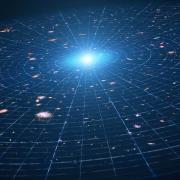
Scientists have released a new study that catalogues the universe by mapping huge clusters of galaxies.
These clusters are some of the largest known objects in the universe — and they can help scientists test theories of how the universe first formed and the rules that govern it today.
The team, led by University of Chicago scientists, used data from the Dark Energy Survey, a project headed by Fermi National Accelerator Laboratory that catalogued the sky for six years from a mountaintop in Chile. They analyzed the number and distribution of these galaxy clusters to try to understand the fundamental laws that govern the universe.
Previously, studies using different techniques had suggested there might be cracks in our understanding of these laws. In particular, there were hints that the universe may have had more structure in the past compared to the model prediction from data today. This could indicate a need for a revision of our current best model of the universe, referred to as the Lambda-CDM model.
But the new analysis reinforces that the Lambda-CDM model remains a good description of what we see around us.
“Our results find that the Lambda-CDM model describes the observable universe well,” said Chun-Hao To, an Eric and Wendy Schmidt AI in Science Postdoctoral Fellow at UChicago, and the first author of one of the papers describing the analysis.
The new study demonstrates that using galaxy clusters to probe the laws of the universe is a valuable method, To said, and lays a framework for analyzing data from the next generation of telescopes as they come online in the following years.
Massive objects
If you zoomed out from Earth, you’d see our little planet tucked inside one of the spiral arms of the Milky Way galaxy. But if you kept zooming out, you’d see that even the Milky Way is just one galaxy in a neighborhood of about 50 others.
Galaxies tend to clump together like this, and while our group is one of the smaller ones, there are others that are simply enormous. These gigantic galaxy clusters are thought to be some of the most massive objects in the universe.
Scientists hoped that by surveying these clusters, they could tease out clues to big questions about the universe, such as the nature of dark matter and dark energy. These forces are hard to understand because we cannot see them directly, but they do respectively push galaxies together or apart.
Because clusters are so massive, it’s easier to see the effects of dark matter and dark energy on them than it would be on smaller objects.
But early studies ran into hiccups. For example, galaxy clusters can be hiding behind each other from our field of view, which throws off some of the calculations.
“Because clusters are such a sensitive measuring stick, if we tallied less clusters, for example, we would conclude a different amount of dark matter in the universe,” explained Chihway Chang, one of the senior authors on the study and associate professor of astronomy and astrophysics at UChicago.
In the new study, Chang and To said, they think they’ve been able to account for these and other complications.
This result adds an interesting data point to an ongoing debate in the cosmology community, known as the “S8 tension.” S8 is a number that quantifies how “clumpy” the universe is, or how much structure it has. In previous work based on a different technique called weak gravitational lensing, scientists calculated S8 as slightly lower than what we infer from the early universe based on the cosmic microwave background.
If true, this discrepancy would be interesting since it would indicate holes in the Lamba-CDM model.
But the new analysis using galaxy clusters falls on the side of the Lamba-CDM model being correct; the S8 value is consistent with the one from the early universe.
“This approach of using galaxy clusters as a test of big cosmological questions is somewhat independent from other measurements,” Chang explained. That’s important to scientists—if they see the same result using different approaches, it makes that conclusion more likely to be true.
Another yardstick
As the next generation of large telescopes comes online, including the Rubin Observatory Legacy Survey of Space and Time and the Nancy Grace Roman Space Telescope, they should tremendously expand the number of galaxy clusters we can map, To said.
Each additional galaxy cluster we can map will offer us much more information.
“We’re glad to demonstrate an analysis scheme that provides us with a different angle on the universe,” said To.
The study involved 66 members of the Dark Energy Survey Collaboration from more than 50 institutions worldwide, including the UChicago-affiliated Argonne National Laboratory and Fermilab.
Part of the research was conducted at the UChicago Research Computing Center.
Citations:
- “Dark Energy Survey: Modeling strategy for multiprobe cluster cosmology and validation for the Full Six-year Dataset.” To et al, Phys Rev D, Sept. 18, 2025.
- “Dark Energy Survey Year 3 Results: Cosmological Constraints from Cluster Abundances, Weak Lensing, and Galaxy Clustering.” T.M.C. Abbott et al, Phys Rev D, Oct. 17, 2025.