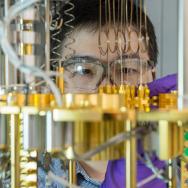
The U.S. Department of Energy announced on Nov. 4 that it has renewed funding for two multi-million-dollar quantum research centers led by Chicago-area national laboratories.
Q-NEXT, a National Quantum Information Science Research Center led by Argonne National Laboratory in partnership with SLAC National Accelerator Laboratory, and SQMS, the Superconducting Quantum Materials and Systems Center, hosted by Fermi National Accelerator Laboratory, will each receive $125 million in funding over the next five years. Both Argonne and Fermilab are affiliated with the University of Chicago and share many University faculty and scientists.
Both centers were originally founded in 2020, as two of five Department of Energy National Quantum Information Science Research Centers created under the National Quantum Initiative Act.
The quantum centers anchor a growing quantum ecosystem in Illinois, which combines two national laboratories, UChicago’s Pritzker School of Molecular Engineering and other world-class academic institutions, the Chicago Quantum Exchange, and leading quantum-focused companies and entrepreneurs.
Leaders met last month to break ground on the Illinois Quantum and Microelectronics Park, a first-of-its-kind park built for quantum technology scale-up and related advanced microelectronics research and development. The renewal of the DOE centers was announced at the eighth annual Chicago Quantum Summit, which has become known as one of the world’s key forums for exploring the full spectrum of global quantum economy needs.
“Quantum information science is a cornerstone of the nation’s technological future, with the potential to transform industries including computing, health care and national security,” said Prof. David Awschalom, the inaugural Q-NEXT director and current chief science officer, who is also a senior scientist at Argonne, the director of quantum engineering at UChicago PME and director of the Chicago Quantum Exchange.
The Q-NEXT Center’s mission is to unlock the future of quantum information by seamlessly integrating quantum and traditional information systems across optical networks.
Q-NEXT brings together two national laboratories, 11 leading universities and six tech companies. Among Q-NEXT’s first-run science breakthroughs: setting a record lifetime—an impressive 5 seconds—for a qubit in silicon carbide; engineering a high-performance qubit based on niobium, a previously understudied core material; and developing a method to pinpoint correlations between magnetic fields picked up by quantum sensors. Q-NEXT also published “A Roadmap for Quantum Interconnects,” which lays out the research and scientific discoveries needed for distributing quantum information in 10 to 15 years.
Building on its achievements over the past five years, the center will focus on demonstrating the potential of distributed quantum entanglement—a phenomenon where qubits, the fundamental unit of quantum information, remain connected even when separated by large distances.
“With a renewed Q-NEXT, we will continue to play an integral role in the national quantum ecosystem through coordinated, complementary efforts with DOE’s other quantum research centers,” said Argonne Director Paul Kearns. “We are committed to realizing the promise of quantum information to build a more connected world and shape a future of scientific progress that strengthens our nation’s security, prosperity and technological leadership.”
The SQMS Center is rooted in Fermilab’s expertise in superconducting radio-frequency (SRF) cavities, materials and cryogenics—technologies originally developed for particle accelerators—and in the lab’s mission to explore the universe at its most fundamental level.
It includes more than 300 experts from 43 partner institutions across national laboratories, universities and industry to advance the next generation of quantum computing, communication and sensing technologies. Together, the team has tackled one of the field’s greatest challenges — extending quantum coherence, the time a qubit can reliably hold information.
Through innovations in materials, fabrication and cavity-based architectures, SQMS has achieved world-leading coherence times and developed the building blocks for its 3D-cavity, qudit-based platforms. The center has also driven progress in quantum sensing, producing record sensitivities and novel methods for dark-matter searches and precision measurements.
“In just five years, SQMS has transformed fundamental understanding into tangible progress — from record-setting coherence times to new materials and devices that redefine what’s possible in quantum technology,” said Anna Grassellino, director of the SQMS Center. “This renewal allows us to build on that foundation and take the next leap: moving from discovery to deployment. Together with our partners across national labs, universities and industry, we’re poised to scale quantum systems to a level that will unlock powerful new tools for science, technology and society.”
“The SQMS Center exemplifies how DOE’s national labs bring together multidisciplinary teams to tackle grand scientific challenges,” said Young-Kee Kim, interim director of Fermilab and the Louis Block Distinguished Service Professor of Physics at UChicago. “Its advances will help secure U.S. leadership in the global race to develop practical quantum technologies.”
More information about the centers is available in news releases from the U.S. Department of Energy, Argonne National Laboratory and Fermi National Accelerator Laboratory.