Editor’s Note: This is part of a series called UChicago Class Visits, spotlighting transformative classroom experiences and unique learning opportunities offered at UChicago.
Anthropology is hardly a new study at the University of Chicago, nor is it a narrow field. But students, particularly in the College, now have opportunity to explore its breadth and depth through a new course: “Anthropology at Chicago.”
The UChicago Department of Anthropology has offered a version of the class for many years in its graduate program, in which new Ph.D. students meet with faculty members, read a bit of their work and discuss their research. It familiarizes students with faculty, but it also offers a sampling of paths that a student could take in the field.
In partnership with Chicago Studies, the department chose to further expose the student body to its professors and its past through a pilot version of the course for undergraduate students, adding some projects and plans to the lessons.
“What we wanted to do was create a course setting where students could hear from the faculty members themselves about the research that they're doing, read a little bit of their recent work and discuss it with them,” said Asst. Prof. Sarah Newman, director of UChicago Undergraduate Studies. “That way, students have an idea of what people are working on, how it relates to their own interests and get a sense of the person behind the research.”
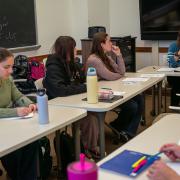
Each time the class meets, the students interact with a different faculty member and have an opportunity to discuss the individual’s research agendas. The conversations happen over lunch, which Newman said helps to create a relaxing, informal atmosphere. In this undergraduate version of the course, the students are also asked to consider how researchers’ current work speaks to the department’s history.
“We're trying to give them a sense of how the discipline of anthropology has changed over time, and how the people who are practicing it now at Chicago come out of different disciplinary traditions, and then we create our own traditions when we all come together here,” Newman said.
This emphasis on history has a distinct purpose, as the UChicago Department of Anthropology will celebrate its 100th anniversary in 2029. The assignments for the undergraduate students in the course include conducting oral histories with current and former faculty and graduate students, as well as researching the University archives’ Special Collections. They’re prompted to think about how the department has become what it is today, with students choosing a topic to research about its history. So far, this has ranged from profiling particular faculty members to exploring the ethics of the discipline.
The late Prof. Emeritus George W. Stocking, a historian of social anthropology at the University, previously assembled an exhibit in the Regenstein Library for the department’s 50th anniversary in 1979. Newman said the students are using Stocking’s exhibition as a jumping-off point for their work—another exhibition, to include the oral histories, is planned for the 100th anniversary.
“There is a certain kind of anthropology that is Chicago anthropology, and this department has been important in the field,” Newman said. “The oral histories and the exhibition are both meant to highlight the fact that this is a place with a rich tradition that's also always changing.”
Yeap Qian Fang, an undergraduate student in the course, said each class challenges how anthropology examines the world, but in the sort of laid-back atmosphere usually found in a reading group. She added that, viewed through the lens of the department’s history, it’s been an opportunity to explore how the field is reflected in historical institutions and power structures as well.
“Aside from the traditional anthropological project of analyzing and studying a given situation or context, almost every faculty member that we have met so far is also very reflective on the role of anthropology as a whole in the world,” Fang said.
Newman said it’s been helpful for students to witness how faculty members have diverse interests, with many working in different parts of the world or on multiple projects. Some faculty are involved in more traditional academic writing, but also curating museum exhibits or producing documentary films. The course illustrates the faculty’s multifaceted work, which Newman said pairs well with the way UChicago students also study a variety of interests.
“As an economics major, a memorable moment for me was interviewing Prof. Alan Kolata for my midterm oral history interview project,” Fang said. “Prof. Kolata works closely with economists and specialists in other fields to publish papers on migration and international development, which is a field that I am planning to pursue. The conversation was meant to serve as a historical record in the archives, but I walked away from the interview absolutely in awe and inspired by how my own fields of interest—economics, anthropology and my other minor, GIS [Geographic Information Science]—can intersect so neatly when I always thought they can never do so.”
—Adapted from an article originally published on the UChicago Department of Anthropology website.